
For many talented professionals in the United States, the H-1B specialty occupation visa serves as a crucial step in their careers. It is a temporary status that provides great opportunities and an end date, creating a genuine desire for a long-term solution. The objective for almost all H-1B holders is the same- in many cases, it is to get a permanent residence, or a Green Card for H1B Visa holders. Moving from an H-1B to a Green Card is generally a multi-step process and H-1B holders ultimately need to attain one of the employment-based categories, primarily EB-2 and EB-3, which have different requirements and timelines.
Understanding the H-1B to Green Card Process
The U.S. employment-based immigration system governs the pathway from H-1B nonimmigrant status to lawful permanent resident status. This process usually entails U.S. employer sponsorship and involves the Department of Labor (DOL) and U.S. Citizenship and Immigration Services (USCIS) in a multi-step application process. It is important that anyone looking to apply for a Green Card knows what each step entails.
The employment-based immigration system has five designated preference categories (EB-1-EB-5). For most H-1B workers, the pathway forward is through either the Second Preference (EB-2) or Third Preference (EB-3) categories, which are specifically for highly skilled workers.
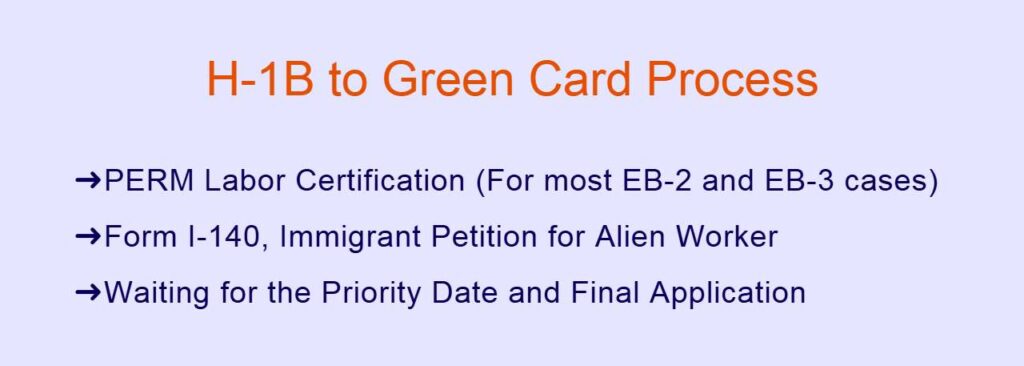
Step 1: PERM Labor Certification (For most EB-2 and EB-3 cases)
The first major step in most EB-2 and EB-3 petitions is the Program Electronic Review Management (PERM) Labor Certification, which the employer will submit to the Department of Labor (DOL). The DOL serves in part by permitting one of its agencies to review the employer’s recruitment efforts and first to remove from the labor market a job position offered, with permanence, to a foreign national based on the determination that there are no qualified, willing, and available U.S. workers for the job.
For an employer, this means a few key steps:
Determining Prevailing Wage: The employer should first request a prevailing wage determination from the DOL to guarantee that the wage offered to the foreign worker is at least the local market rate for the occupation.
Recruitment of U.S. Workers: The employer must engage in a strict recruitment process (such as job advertisements and notices) to test the U.S. labor market. Recruitment is a regulated and strict process designed to protect U.S. workers’ interests.
ETA Form 9089 will be filed: If the required recruitment does not yield any qualified U.S. workers, the employer will file ETA Form 9089, Application for Permanent Employment Certification.
The only way for the process of obtaining a Green Card for Employment-Based Immigrants to progress to the next step is for the DOL to approve a labor application. The DOL’s approval assures the H-1B worker that hiring such a worker will not have an adverse effect on the wages and working conditions of their U.S. counterparts.
Step 2: Form I-140, Immigrant Petition for Alien Worker
With an approved PERM Labor Certification application (or a waiver of PERM in cases such as EB-2 National Interest Waiver or EB-1), the employer would now file Form I-140, Immigrant Petition for Alien Worker, with USCIS. This petition serves to verify the employer’s intention to hire the foreign worker permanently, and also confirms that the foreign worker meets the requirements to fill the position in the identified EB category (EB-2 or EB-3). The date of the I-140 filing (or when the DOL takes action on the PERM application) is considered the individual’s priority date, which establishes that person’s place in line for their visa number. An approved I-140 represents a significant achievement in the overall H-1B to Green Card transition.
EB-2 vs. EB-3: A Critical Choice for H-1B Holders
Selecting the appropriate employment-based category is an important consideration that may impact the final Green Card waiting period for H1B Visa holders. In all cases, both categories can (and often lead to) permanent residency, however, the process of eligibility in each category usually affects the overall time frame.
The EB-2 Category: Advanced Degrees and Exceptional Ability
The EB-2 category is by far the more desirable because it usually has shorter wait times than the EB-3, though this differs across countries of origin and according to demand based on the Visa Bulletin. An H-1B worker may qualify for an EB-2 Visa if they meet one of the following criteria:
Master’s Degree: The position requires, and the foreign national possesses, a Master’s degree (or higher), or a Bachelor’s degree and five years of progressively responsible post-baccalaureate experience in the field. This is typically a professional position that H-1Bs often accommodate with this level of education, making the EB-2 category a natural fit.
Exceptional Ability: The foreign national can demonstrate an ability to provide services in the sciences, arts, or business that is significantly above that normally encountered in the position. To do this, the foreign national must meet at least three of the six regulatory criteria set by USCIS, such as major awards, publications, or remuneration that is at least higher than the average wage.
The National Interest Waiver (EB-2 NIW) distinguishes itself from other EB-2 provisions by permitting an applicant to self-petition and eliminate the requirement for PERM Labor Certification and an employer sponsor if the work is considered to be in the national interest of the United States. For high-caliber professionals whose work is considered to be of great significance and national importance, this provides a faster, independent-of-employer pathway. The NIW process directly deals with one of the primary difficulties with the EB-2 process by eliminating the need for an employer, although applicants still need to demonstrate that the applicant’s proposed work will benefit the United States in order to qualify.
The EB-3 Category: Skilled Workers and Professionals
The EB-3 classification is a primary pathway for a Green Card for Employment-Based Immigrants for professionals who may qualify but not meet the more stringent EB-2 qualifications.
The EB-3 classification is divided into three sub-classifications:
Skilled Workers: Requires at least two years of experience or training in the job, which is not seasonal or temporary.
Professionals: Requires a U.S. Bachelor’s or foreign equivalent. Many H-1B workers initially qualify in this sub-classification using the educational qualifications.
Other Workers (Unskilled): Requires less than two years of experience or training in their jobs.
While the EB-3 classifications are typically easier to qualify under and more broadly defined, the related backlog for a visa number may be longer than for EB-2, especially in a high-demand category (e.g., China and India). This may make early planning and establishing the proper priority date a critical aspect of the overall H-1B to Green Card process. Many times individuals carefully consider whether an EB-2 would better qualify an individual to be able to potentially shorten the decade-long waits that some EB-3 backlogs experience.
Step 3: Waiting for the Priority Date and Final Application
Once the I-140 has been approved, the applicant enters the last and sometimes the longest stage of the H-1B to Green Card transition: waiting for a visa number to become available due to the applicant’s priority date, country of chargeability, and preference category (EB-2 or EB-3).
The U.S. Department of State publishes a monthly Visa Bulletin that details the cut-off dates for all employment based categories. An applicant may only proceed with the last step, Adjustment of Status (Form I-485), when their priority date is current in the Visa Bulletin’s Final Action Dates.
Again, this is where the H-1B visa is stable. The non-immigrant status must continue until the Green Card is approved. Thankfully, the American Competitiveness in the Twenty-First Century Act (AC21) allows H-1B status to extend beyond the 6-year limit when the Green Card process begins, which allows for continuous employment and residence. Maintaining H-1B to Green Card Eligibility during this sometimes very lengthy wait is a priority for applicants and employers alike.
Adjustment of Status (AOS) vs. Consular Processing
When a visa number is current, the final application step occurs:
Adjustment of Status (AOS): If the applicant physically resides in the U.S. and eligible, they Apply for a Green Card by filing Form I-485 with USCIS. This is the most common option because the individual can remain in the U.S. during processing and receive employment authorization (EAD) and advance parole (travel document).
Consular Processing: In the event that the applicant is outside the U.S. or ineligible for AOS, they will process their application through a U.S. Consulate abroad.
The I-485 or immigrant visa is finally approved and the applicant has successfully transitioned to a Green Card holder.
How FRR Immigration Can Help
The H1B Visa holders Green Card process is complicated, and not only requires legal expertise but requires strategic planning with regards to the subtleties of the EB-2 and EB-3 categories. As your trusted immigration partner, FRR Immigration has the specialized knowledge to assist you through each part of this H-1B to Green Card Eligibility process.
Initial Eligibility Assessment: We complete a thorough analysis of your education and professional experience to identify the best category (EB-2, EB-3, or EB-2 NIW) for Green Card for Employment-Based Immigrants purposes, and to position you as strategically as possible in order to pursue the quickest option viable for you, and help guarantee your future in the U.S.
PERM Strategy and Management: We partner with and manage your sponsoring employer through the entire PERM Labor Certification process. This entails ensuring total compliance with all DOL regulations, such as establishing an accurate prevailing wage determination and effectively and comprehensively executing each step, in the recruitment process, ensuring you are positioned to defend an application from audit and delays.
Timeliness and Accuracy in I-140 Petition Filing: We draft and submit your I-140 petition, utilizing timeliness and accuracy while ensuring each legal requirement is met and every one of your supporting documents is presented in the best possible manner. There is a significant value to an earlier priority date in the H-1B to Green Card process, and we treat this matter with care and attention.
Priority Date Management Guidance: We monitor the monthly Visa Bulletin, and advise you when it is optimal to file for a I-485 adjustment of status. We also help you remain in lawful status under AC21 H-1B extensions and make sure we place you in a position to take advantage of any advancement in visa cut-off dates.
Adjustment of Status (AOS) and Consular Support: Our team will assist you and your dependents with taking their documentation that you will need to apply for a Green Card (Form I-485), getting ready for the biometrics appointment and any interview needed for the adjustment of status, or managing the consular process if you are outside of the U.S.
Do not risk your permanent residency and someone else’s view of what is best for you. The Green Card for H1B Visa holders is really your future in the U.S., and speaking with someone who is experienced will make a difference. Please call FRR Immigration today to schedule your consultation to talk about your permanent residency options.
Quick FAQ for H-1B to Green Card Transition
What is the first step for EB-2/EB-3?
The employer must obtain PERM Labor Certification from the Department of Labor (DOL).
What is my “Priority Date?”
The filing date of the PERM application (or the I-140 if no PERM is required). This locks in your place in the visa queue.
Can I self-petition for a Green Card?
Yes, if you meet the high criteria for the EB-1A (Extraordinary Ability) or the EB-2 National Interest Waiver (NIW).
Can I change jobs after I-140 is approved?
A: Yes, but carefully. You can retain your priority date. If your Form I-485 (Adjustment of Status) has been pending for 180 days or more, you can “port” your petition to a new job in the same or a similar occupation under AC21 rules.
What is the fastest employment-based category?
A: Generally, the EB-1 (First Preference) category is the fastest route due to less demand and higher preference.
Read more: From H1B to Green Card: Your Path to Permanent Residency